MP3Juice Browser Based Music Download Guide
At a glance
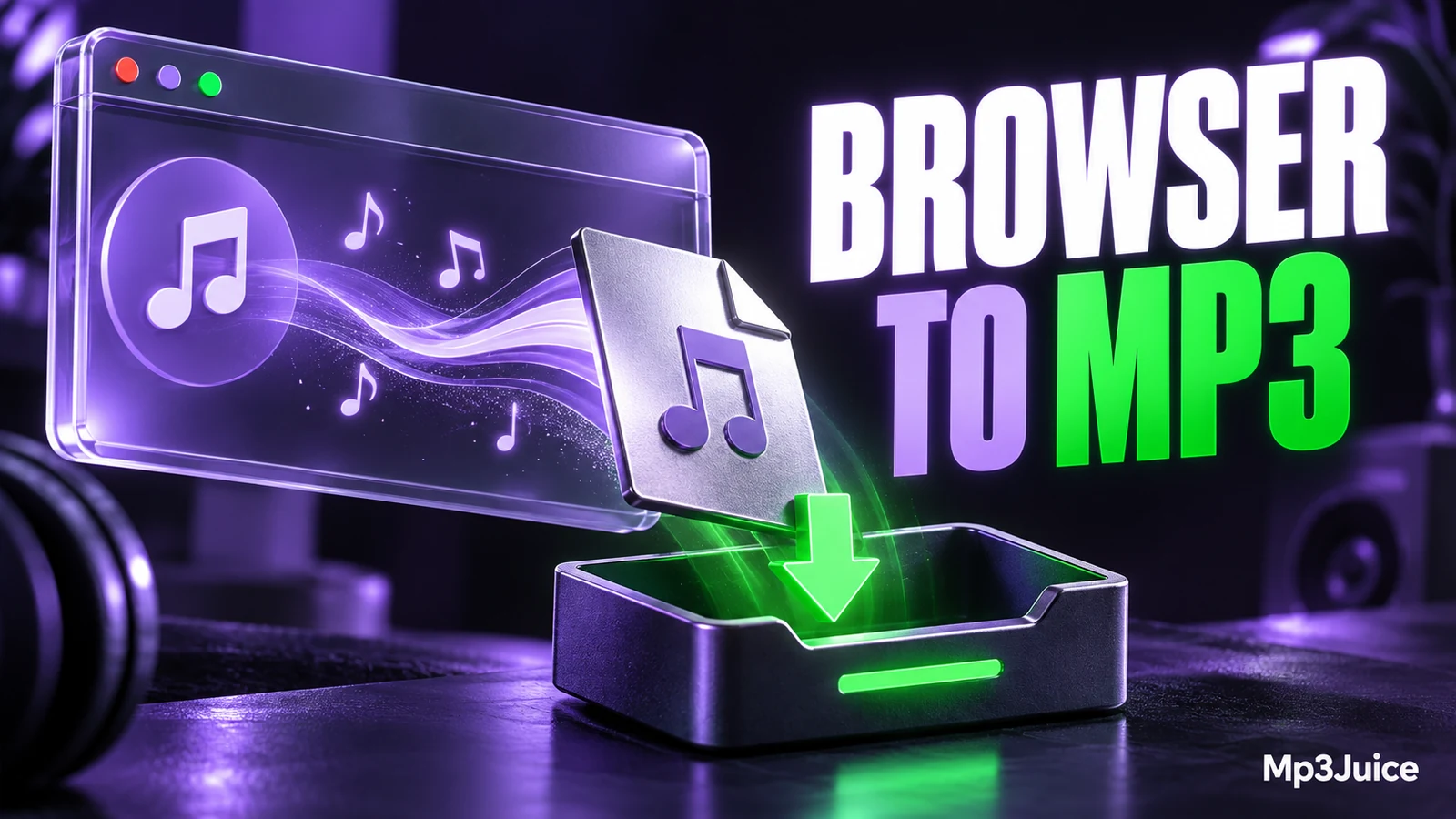
A browser-based download moves from search to result selection, format choice, embedded provider, completed transfer, and local playback. Results, previews, and widgets are not saved files until the browser finishes the download.
In this guide
- Browser Roles in the Download Flow
- Search Tab: Query, URL, and Paste Permission
- Result Controls and Format Choices
- Handoff Diagram: Page to Local Player
- Embedded Provider, Visible Status, and Storage
- Practical Example: One Fictional Track
- Permission Boundaries and Closing the Tab
- Single-Track Use and Playlist Expectations
- Short FAQ
A browser-based music download flow separates searching, choosing a result, selecting a format, saving the file, and playing it later. On the MP3Juice homepage, the search box accepts a song title, an artist name, or an individual YouTube URL. The workflow requires no account, payment, app, APK, or browser extension for a single-track search.
The key point is simple: a visible result is not a completed download. A Play button may preview a result when available, and a format widget may appear below a selection, but the file becomes local only after the browser finishes saving it to the device or to the configured download location.
Browser Roles in the Download Flow
The page runs inside a normal browser tab, so several browser-controlled steps are involved. The search tab accepts the query. The results area shows possible matches and controls. The Download control opens MP3 and MP4 choices. Selecting Download MP3 or Download MP4 loads an download panel below the chosen result. After that, the browser handles the transfer record, the save location, and later access to the file.
This distinction matters because pages can display, preview, or prepare content without writing a file into local storage. Until the browser creates a completed download record, the item is still part of the page session rather than a file you can use independently.
Search Tab: Query, URL, and Paste Permission
The search field accepts ordinary typed text, manual paste, or an individual YouTube URL. If a paste feature reads directly from the clipboard, the browser may ask for clipboard permission. That permission concerns the current paste action. It does not give the page access to folders, private files, or a music library.
After you submit a search, the results heading can keep the searched query while the input field becomes empty. That is normal page behavior: the heading preserves context, while the empty box is ready for another search. If you are deciding whether to search by title or by a single video link, the MP3Juice YouTube to MP3 Search Guide covers that choice in more detail.
Result Controls and Format Choices
Result controls should be read by label. Play is a preview control when a preview is available. It does not create an MP3 or MP4 file. If a preview is unavailable, that only means the preview cannot be played for that result at that moment.
Download is the results control that opens format choices, commonly MP3 and MP4. MP3 is for audio playback. MP4 is a video container when offered. Choosing a format starts the next stage, but it is still not proof that a file has been saved.
Download MP3 and Download MP4 load the download panel below the selected result. That widget helps prepare the chosen format, while the browser still needs to complete the final transfer. Download Now is separate promotional wording and should not be confused with the results Download control. Availability varies, and finding a result does not itself grant permission to copy, store, or reuse it.
Handoff Diagram: Page to Local Player
| Stage | Browser role | Boundary | If the tab is closed |
|---|---|---|---|
| Search tab | Sends a typed title, artist, or individual YouTube URL and displays results. | Clipboard access may be requested only for paste actions. | Searching alone leaves no local file. |
| Results and preview | Shows matches and may play a preview in the tab. | Preview playback is not storage. | The preview stops; no saved file is created. |
| Format choice | The Download control reveals MP3 or MP4 choices. | A visible option is preparation, not completion. | The choice disappears unless a download already finished. |
| Embedded provider | Download MP3 or Download MP4 loads the download panel below the result. | The provider still depends on the browser transfer. | An unfinished provider step leaves no usable local track. |
| Transfer record | The browser records the download in its downloads area or history. | The save location follows browser and device settings. | A completed file remains after the tab is closed. |
| Local player | A compatible player opens the saved file. | The player needs access to the chosen file. | The browser tab is no longer needed for that saved file. |
The reason for separating these stages is practical. A browser can show a page, stream a preview, and load an embedded provider without changing what is stored on your device. Only the completed transfer stage creates a file you can open later outside the page.
Embedded Provider, Visible Status, and Storage
When the download panel appears below a result, it is part of the format-preparation step. Because it is embedded in the page, it does not become a application and does not give the page general control over the device. Treat visible widgets, format labels, and progress-like page elements as preparation until the browser shows a download prompt, a progress item, a completed file, or a download-history entry.
If your browser opens an audio file in a tab instead of saving it, that is a browser handling behavior, not evidence that the file was imported into a music library. The guide on why an mp3 opens in the browser instead of downloading explains that situation separately.
In Chrome, completed files can usually be found through Downloads or Download history, with the destination depending on browser settings. On iPhone or iPad Safari, downloads can be found in the Files app under the configured Downloads location, often iCloud Drive or On My iPhone. A cloud placeholder is not guaranteed to be fully local. A saved MP3 is also not automatically imported into Apple Music; a compatible local player or a separate library step is needed.
Practical Example: One Fictional Track
Suppose you search for the fictional song Lanterns Under Cedar Rain by the fictional artist Mara Vale. You type the title, submit the search, and the results heading keeps the title while the input field clears. That confirms the page is showing results for your query, not that anything has been saved.
You press Play on one result to preview it, if preview playback is available. Next, you choose the result’s Download control and select MP3 because you want an audio file rather than a video container. The embedded provider appears below the selected result. The important decision is to wait for the browser transfer, because the provider stage is still inside the page. Only after the browser finishes the download does the track become available for a compatible local player.
Permission Boundaries and Closing the Tab
The browser creates clear boundaries. The page receives the search text or URL you enter. Clipboard access may be requested for a paste action. The page can display results and embedded provider content. The browser controls whether a transfer is saved, where it is saved, and how it appears in download history. After saving, a local player controls playback.
Closing the tab ends the active page session, but it does not undo a completed download. If the transfer finished, the file remains wherever the browser saved it. If you only searched, previewed, selected a format, or loaded the widget, you should not expect a usable local file. Renaming an extension is not conversion; changing .mp4 to .mp3 does not turn video into audio.
The browser-based design is also why no application is required for this workflow. For that distinction, see Use MP3Juice Without Installing an App. If your concern is using the search flow without sign-up, MP3Juice Without Registration or Account Setup explains the no-account path.
Single-Track Use and Playlist Expectations
This flow is built around individual searches and individual downloads. There is no playlist or batch download function in the browser workflow. If you want a playlist, assemble it separately from individually saved authorized files in a compatible player. That separation is important because playlist organization belongs to the player, while the browser page handles one selected result at a time.
For a focused audio-search entry point, the MP3 Downloader page supports single-track use. The same sequence applies: search or selection first, format handling next, completed browser download last, then playback in a compatible local player.
Short FAQ
- Is a result the same as a download?
No. A result is a possible match. A download exists only after the browser finishes saving the file. - Does Play save the track?
No. Play is only a preview when available. - Can I download a whole playlist at once?
No. Save individual authorized files and organize them later in a compatible player.