MP3Juice 320kbps Audio Quality Explained
At a glance
320kbps describes MP3 bitrate, not source quality or guaranteed output. A higher-rate re-encode cannot recover lost detail. Use bitrate labels cautiously, estimate file size with CBR math, and choose smaller rates when storage, data, or casual listening matter more.
In this guide
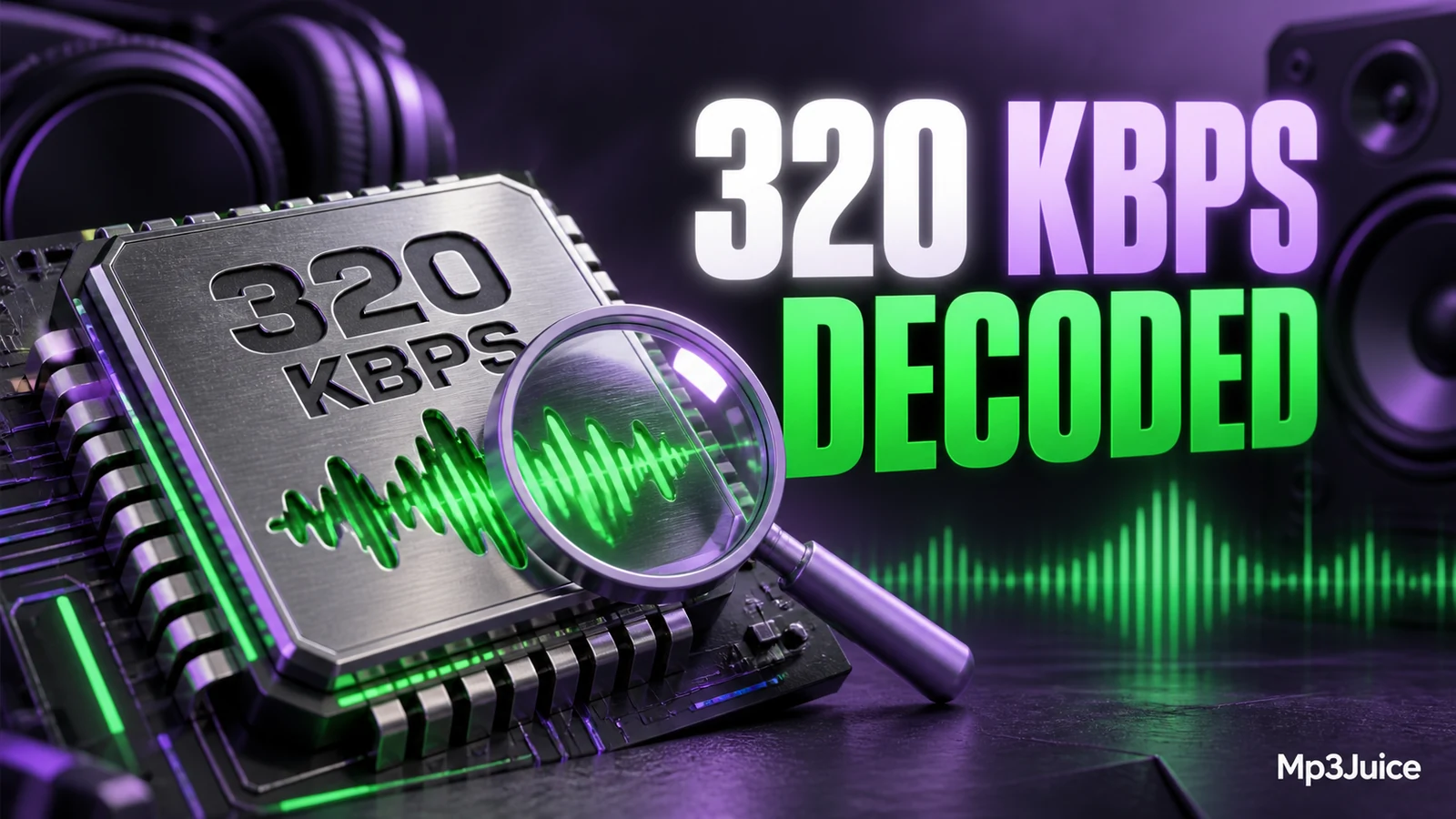
320kbps means an MP3 bitrate of 320 kilobits per second, not proof that the audio came from a high-quality original. On MP3Juice, a displayed range such as “192-320kbps” should be read as a general label, not as a confirmed technical inspection of the file you may receive. A higher bitrate can preserve more detail when the source already contains that detail, but it cannot rebuild music information that was removed by earlier lossy compression.
This distinction matters because “320kbps” is often treated as a shortcut for “best version.” In practice, it is only one property of an audio file. Source quality, encoding history, sample rate, bit depth before conversion, playback equipment, and the listening environment all affect what you hear. For MP3 specifically, bitrate is important, but it is not a certificate of provenance, originality, or lossless quality.
What 320kbps Really Means
Bitrate describes how much data is allocated to represent each second of compressed audio. At 320kbps, an MP3 stream uses about 320,000 bits per second. In a constant bitrate file, that rate stays steady throughout the track. In a variable bitrate file, the encoder may use more data for complex passages and less for simpler sections, so the average rate and final file size can vary.
MP3 is a lossy format. It reduces file size by discarding audio information the encoder predicts will be less noticeable to human listeners. A well-made 320kbps MP3 from a clean source can sound very good to many people, especially in everyday listening. However, “very good” is not the same as lossless. Once information has been removed during lossy encoding, saving the file again at a higher bitrate does not restore the missing content.
It also helps to separate bitrate from other audio terms. Sample rate describes how many audio samples are taken per second, such as 44.1 kHz. Bit depth applies to uncompressed or lossless digital audio and describes the resolution of each sample. Bitrate, by contrast, describes the amount of compressed data used over time. These properties are related to audio quality, but they are not interchangeable.
Why a 320kbps File Can Still Sound Limited
A 320kbps MP3 can only encode what it is given. If the input was a clear studio master or another high-quality source, the encoder has more musical detail to preserve. If the input was already a low-bitrate MP3, a distorted upload, a clipped recording, or a noisy capture, the 320kbps output may simply preserve those flaws in a larger file.
Think of it like enlarging a small, blurry image. The bigger file may have more pixels, but the missing detail from the original scene does not magically appear. Audio transcoding works in a similar way. A 128kbps source converted to 320kbps may show a larger bitrate property afterward, yet the fine ambience, high-frequency texture, and transient detail removed during the first compression stage remain absent.
For a more focused explanation of this common mismatch, see why a 320 kbps mp3 can still sound bad. The central point is simple: bitrate describes the container’s data rate, not the trustworthiness of the source.
File Size Example for a Five-Minute CBR MP3
For constant bitrate MP3 files, you can estimate size with a straightforward decimal formula: MB = kbps * seconds / 8000. This excludes tags, cover images, and other metadata, so real files may be slightly larger. It is an illustrative calculation, not a measured promise for any particular download.
| Bitrate | Calculation | Approximate Size |
|---|---|---|
| 128kbps | 128 * 300 / 8000 | 4.8MB |
| 192kbps | 192 * 300 / 8000 | 7.2MB |
| 256kbps | 256 * 300 / 8000 | 9.6MB |
| 320kbps | 320 * 300 / 8000 | 12MB |
The same rule also explains smaller examples. A three-minute file at 128kbps is about 2.88MB because 128 * 180 / 8000 = 2.88. Variable bitrate files are less predictable because the encoder changes the rate according to the audio content. A quiet acoustic passage and a dense chorus may not use the same amount of data.
How Displayed Quality Labels Should Be Read
When a result shows a bitrate range, it is best understood as a displayed indication rather than a per-file guarantee. A visible option is not the same as a completed local download, and a range such as “192-320kbps” does not prove the exact bitrate, encoding method, or source quality of the file that may be produced.
The search page accepts a song title, artist name, or an individual YouTube URL. If you use paste, the browser may ask for clipboard permission, but manual paste remains possible. After the main Download button is used, results can retain the searched query in the heading while the input field becomes empty. In the result area, Download opens MP3 and MP4 choices. Play may preview a result when available. Choosing Download MP3 or Download MP4 loads an external widget below the selection area. “Download Now” is a separate promotional link and should not be confused with the Download control that shows format choices.
None of these interface steps create a guaranteed 320kbps selector. Availability can vary, and finding a result does not itself grant permission to copy or reuse the underlying work. The practical takeaway for this topic is narrower: read bitrate labels cautiously, and do not assume the displayed range confirms a true 320kbps source.
Practical Example with a Fictional Song
Imagine you search for the fictional track “Glass Orchard” by the fictional artist Nera Vale. The results heading keeps your query, and you open the Download option to choose MP3. A label near the result suggests “192-320kbps.” That label may make the file sound like a premium version, but it does not tell you whether Nera Vale’s fictional upload began as a clean high-resolution export, a compressed video soundtrack, or a previously encoded low-bitrate MP3.
If the original audio available to the conversion process was already limited, a 320kbps output would mostly create a larger file containing the same limitations. You might still prefer it if storage is not a concern, but the reason should be realistic: you are choosing a higher data rate where available, not recovering missing studio detail.
When Smaller Bitrates Are Practical
A smaller bitrate is not automatically a bad choice. It can be practical when the listening situation does not reveal small quality differences or when file size matters more than maximum fidelity. Mobile storage, limited data plans, older devices, and quick reference listening all change the decision.
| Situation | Practical Choice | Why It Can Make Sense |
|---|---|---|
| Careful music listening with good headphones | Higher bitrate, when the source is good | Detailed music benefits most when the original audio has detail worth preserving. |
| Casual listening on small speakers or earbuds | 128-192kbps may be enough | The playback setup and background noise may mask differences that are obvious in quieter conditions. |
| Speech, notes, interviews, or simple spoken content | Lower bitrate can be practical | Speech usually has less musical complexity than full-range music, so smaller files may remain understandable. |
| Saving mobile data or device space | Choose smaller files where acceptable | Lower bitrate reduces file size, which helps when the priority is storage or bandwidth rather than fine detail. |
For data-focused listening choices, Reduce Data Usage When Using MP3Juice explains how file size decisions affect everyday use. The important “why” is that audio quality is only valuable if your source, device, and listening conditions let you benefit from it. A larger file is not always the smarter file.
MP3, MP4, and Device Compatibility
MP3 and MP4 should not be treated as two bitrate levels. MP3 is an audio format. MP4 is a container that often carries video and audio, though the exact playback support depends on the codec and the device or player. Choosing MP4 does not mean the audio is automatically better, and choosing MP3 does not prove the bitrate is exactly 320kbps.
If your goal is audio-only playback across many devices, MP3 is usually the simpler choice. If you need a video container, MP4 may be relevant, but compatibility depends on more than the file extension. For format and playback considerations, see MP3Juice Audio Formats and Device Compatibility. For audio-only searching and conversion context, the MP3 Downloader page is the more relevant destination.
Quick Answers About 320kbps
- Does 320kbps prove the file came from a high-quality source?
No. It states a bitrate value or displayed range, not the source history. - Can converting a low-bitrate MP3 to 320kbps improve it?
It can create a larger file, but it cannot restore detail already removed by lossy compression. - Is there a guaranteed 320kbps selector?
No guaranteed site selector should be assumed. Download shows format choices such as MP3 and MP4, not a confirmed 320kbps quality control. - Is 320kbps always the best practical choice?
Not always. If the source is poor, or if you are saving data and listening casually, a smaller bitrate may be more practical.
Use 320kbps as one clue, not the whole judgment. The best reading is: higher bitrate can help preserve a good source, but it cannot prove the source was good, and it cannot reverse earlier compression loss.