MP3Juice Audio Formats and Device Compatibility
At a glance
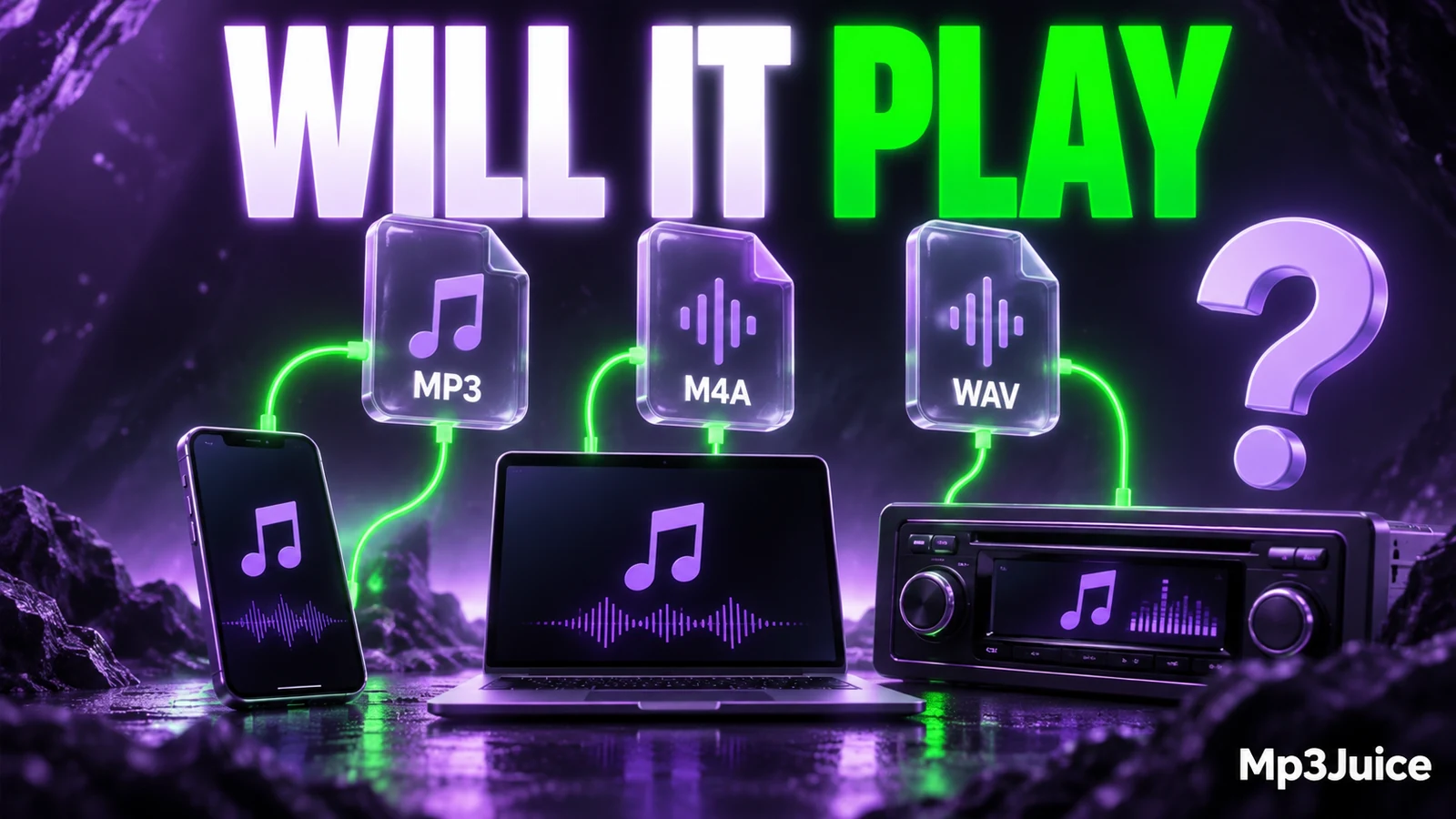
MP3 is usually best for audio-only compatibility, while MP4 suits video-capable players. Playback depends on the actual container and codec, not just the file extension, so match the format to your device and avoid rename-to-convert mistakes.
In this guide
Choosing between MP3 and MP4 is a device compatibility decision. MP3 is usually the safer audio-only choice, while MP4 is a container commonly used for video-capable playback. When you search with MP3Juice, the right format is the one your intended player can actually open, not merely the extension that looks familiar.
The homepage search accepts a song title, artist, or an individual YouTube URL. If you paste, the browser may ask for clipboard permission, although manual paste remains available. The main button is Download. On a results, Download opens MP3 and MP4 choices, and Play may preview a result when available. Selecting Download MP3 or Download MP4 loads an external widget below the selection. A visible option is not the same as a completed local download.
Extension, Container, and Codec Are Different Things
A file extension is the part after the final dot in a file name, such as .mp3 or .mp4. It helps your operating system decide which apps may handle the file, but it is only a label. If the media inside the file does not match the label, a player may reject it or open it incorrectly.
A container is a wrapper that holds media streams and timing information. MP4 is a container. It can hold video, audio, subtitles, or other data depending on how the file was made. That is why two files ending in .mp4 may not behave the same on every device.
A codec is the compression method used for the actual media stream. MP3 is a lossy audio format and familiar file extension. AAC is another common audio codec often found inside MP4 or M4A-style files. The real compatibility question is: does your player support the container and the codec inside it?
When to Choose MP3 or MP4
Choose MP3 when your goal is audio-only listening across many devices. Older car stereos, USB speaker systems, basic portable players, and many desktop music apps are more likely to recognize MP3 than an MP4 container. MP3 is also the more predictable choice when you want a track to behave like a song in a music library.
Choose MP4 when you specifically want video or when the intended app is designed for video playback. A phone may open an MP4 through a video player while a music app ignores it. That is not always a broken download; it may simply be the app sorting media by purpose.
The reason is plain: music apps are usually built around audio track files, while video players are built to open containers like MP4 and decode video and audio together. If your question is specifically about compressed audio choices, the guide to mp3 vs m4a and aac gives a narrower comparison.
What the Download Choices Actually Mean
The results Download control opens format choices. After you choose MP3 or MP4, an external widget loads below the selection. That is still part of the download flow; it does not prove that a file has already landed on your device.
Download Now is a separate promotional link, not the Download control that exposes MP3 and MP4 choices. This distinction matters because clicking a promotional action can lead you away from the expected file workflow.
Availability can vary by result. A preview may appear for some results and not others. Finding a result also does not itself grant permission to copy or save the media. For compatibility troubleshooting, first confirm that the file truly finished saving, then test it in the right type of player.
Troubleshooting Table: Match the File to the Player
| Situation | Likely issue | Best next step | Why this helps |
|---|---|---|---|
| Older car stereo or USB speaker does not show the file | MP4 container or unsupported codec | Use the MP3 choice instead | Basic audio hardware commonly expects audio-only files and may ignore video containers. |
| MP4 plays in a phone video app but not in the music app | The music app may not index video containers | Open it in a video player, or use MP3 for music-library use | Music libraries usually organize track-style audio files, not video containers. |
| File is visible on iPhone or iPad but not in Apple Music | The saved file is not automatically imported | Use a compatible local player or a supported manual import method | Browser downloads and Apple Music library entries are separate workflows. |
| Chrome says the download finished, but you cannot find it | The saved location differs from what you expected | Check Chrome Downloads or Download history | The browser records completed downloads, and the destination depends on settings. |
Changing .mp4 to .mp3 still fails | The file was renamed, not converted | Get the correct format or use compatible conversion software you already trust | The player reads the media structure inside the file, not just the name after the dot. |
The table focuses on the checks that matter most: the player must support the file’s structure, the file must be fully saved, and you need to know where the browser placed it. Renaming an extension is not a conversion because it does not rebuild the media data inside the file.
Finding Files on Desktop, iPhone, and iPad
On a desktop or laptop, the download destination depends on browser settings. Chrome offers Downloads and Download history, which are useful when the file is not where you expected. Once you find it, open MP3 files with an audio player and MP4 files with a video-capable player. For a broader computer workflow, see Using MP3Juice on PC, Mac, and Laptop.
On iPhone and iPad, Safari downloads can be found in the Files app under the configured Downloads location, often iCloud Drive or On My iPhone. A cloud placeholder is not guaranteed to be stored locally at that moment. A saved MP3 also does not automatically appear in Apple Music; you need a compatible local player or a supported import path.
A file manager, music player, and video player answer different questions. The file manager shows whether a file exists. The music player shows whether it can read the file as audio. The video player shows whether it can open the MP4 container and its streams.
Bitrate Labels and File Size Expectations
MP3 is lossy audio, so transcoding cannot restore source detail that has already been removed. Bitrate, sample rate, and bit depth are different properties. The listening result depends on the source and encoding path, not just a number beside a format option.
A displayed label such as 192-320kbps should not be treated as proof of the actual file’s measured properties. It is not a guaranteed quality selector, not a promise of 320kbps output, and not lossless reproduction. For constant bitrate MP3, an approximate decimal size is kbps × seconds / 8000, excluding tags and small overhead. A five-minute file at 320kbps is about 12MB, while a three-minute file at 128kbps is about 2.88MB. Variable bitrate files can differ.
For compatibility, format support usually matters more than a bitrate label. A player that cannot read an MP4 container will not be fixed by a different displayed bitrate. If your focus is audio quality rather than device recognition, read the MP3Juice High Quality Audio Download Guide.
A Practical Fictional Example
Imagine you search for the fictional track Harbor Lights Sketch by the fictional artist Luma Vale. You want to play it through an older car stereo from a USB drive. The result offers MP3 and MP4 choices, and you choose MP4 because it seems more complete. The stereo does not list it.
The likely issue is not the song title or the USB drive name. The stereo probably scans for common audio files and ignores MP4 containers. The practical fix is to choose MP3 for that use case because the device is built for audio-only playback.
Now imagine the fictional live clip Blue Lantern Session by the fictional group North Pier Trio. If you want to watch the clip on your phone, MP4 may be sensible, but you should open it in a video-capable app. If you want it to behave like a normal song, MP3 is the more predictable choice.
Quick Answers
- Can renaming convert a file? No. Changing
.mp4to.mp3changes the label only. - What gives the broadest audio playback? MP3 is usually the safest choice for audio-only listening across mixed devices.
- When is MP4 better? Use MP4 when you want video or know your player supports the MP4 container and its codec.
- What if the choice appears but the file is missing? Recheck the download step and browser history. For issue-specific help, see Fix Common MP3Juice Download Problems.
The simplest rule is to choose based on the player. MP3 is the practical audio-first option. MP4 is the container choice for video-capable playback. If you are starting from an individual video URL and only need audio, the YouTube to MP3 page fits that narrower task.