How to Tell a Studio Track From a Live Version or Remix
Compare titles, credits, duration, and listening cues to identify the recording you want and label alternate versions accurately in your library.
At a glance
A live performance, remix, radio edit, and studio track can share a title while containing noticeably different audio. Compare version labels, duration, credits, and the recording itself. Keeping accurate filenames and tags helps preserve those distinctions in your library.
In this guide
To distinguish a studio track from a live version or remix, combine the title and release details with listening cues. Duration, audience sound, arrangement, vocal delivery, and credits can all help. No single clue identifies every recording reliably.
The underlying song and a particular recording are different things. Two files can share the same song title while containing performances or edits you would want to keep separately in a library.
Start with the version label
Look for words such as live, acoustic, remix, instrumental, radio edit, extended, or remastered. These labels provide an initial direction, but they can be incomplete, inconsistent, or added by an uploader rather than the original release.
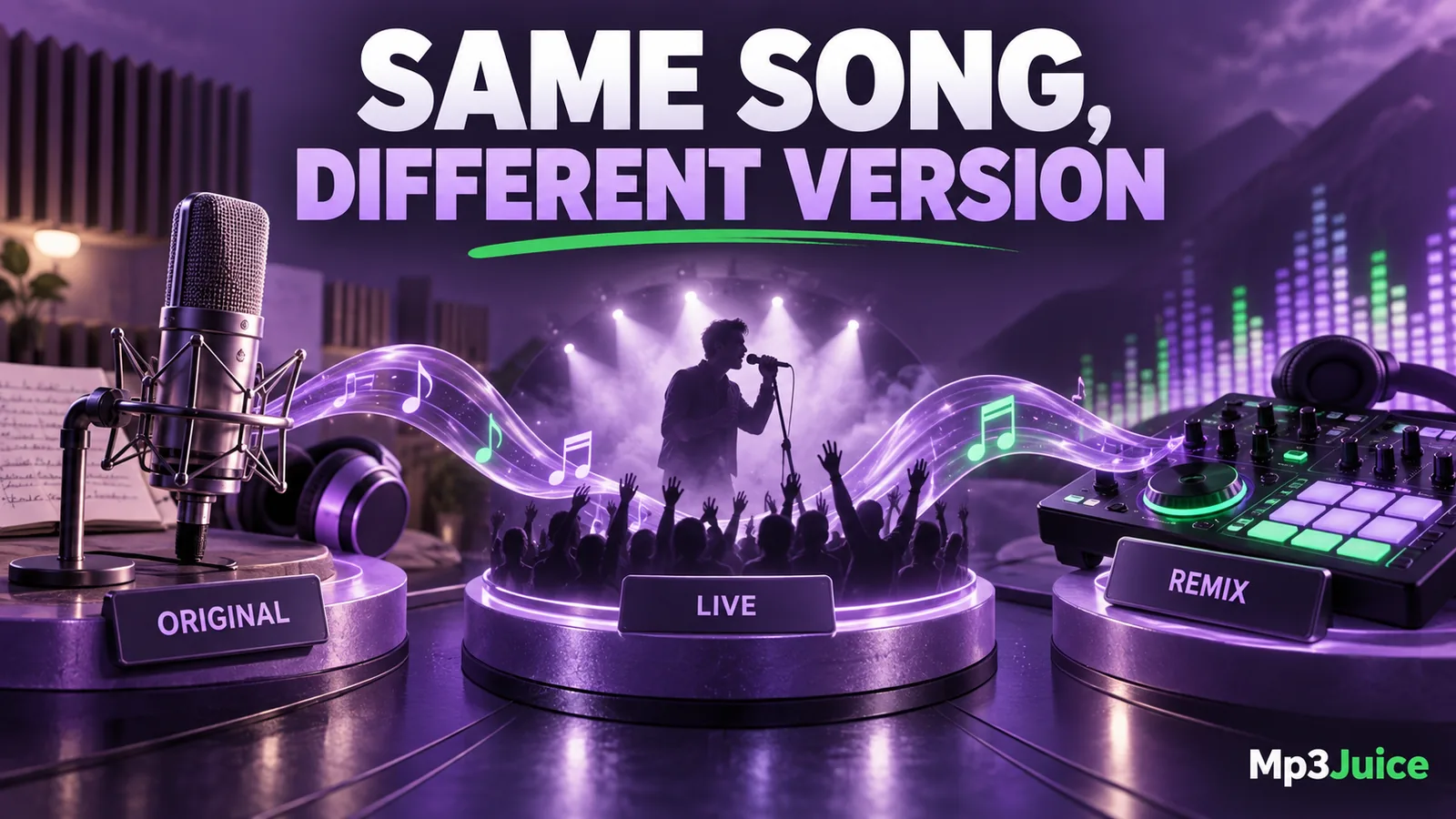
A studio version generally refers to a recording produced in a studio context. A live version refers to a performance captured live, though it may still be edited or processed afterward. A remix changes a mix or arrangement using recorded material, with the exact scope varying widely.
A remaster usually refers to new mastering of an existing mix or source, rather than a wholly new performance. It can sound different in loudness or tonal balance without introducing a new vocal take. Treat the label as context to verify, not a complete technical history.
Listen for performance clues
Audience noise, stage announcements, room ambience, and altered vocal phrasing can suggest a live recording. A different tempo, instrumental solo, or ending can also reveal that the performance differs from the familiar studio version.
Absence of applause does not prove that a recording is a studio version. A live capture can be edited tightly, and an intimate performance may have little audience noise. Conversely, a studio production can deliberately include crowd sounds.
Use several clues together. Compare a recognizable vocal phrase, an instrumental entrance, and the ending. If those moments differ, you may be hearing a different performance rather than a change caused by MP3 encoding.
Distinguish an edit from a different performance
A radio edit may shorten an introduction, remove an instrumental section, or change the ending while retaining the same basic recording. An extended version may keep additional sections. A clean edit can alter particular words without changing the entire performance.
Compare the structure around the difference. If the vocal and arrangement match but a section is missing, an edit is a plausible explanation. If phrasing, timing, and instrumental details change throughout, a separate performance is more likely.
Duration helps narrow the possibilities but does not prove identity. Silence, spoken introductions, playback speed changes, or upload trimming can alter length. Keep the specific listening observation alongside the time comparison.
Identify remix and alternate-mix clues
A remix can feature a new beat, changed instrumentation, rearranged sections, or different emphasis in the mix. Some remixes are obvious, while others retain much of the original performance and change only certain elements.
Look for a credited remixer or a release-specific title. If the description is uncertain, avoid assigning a confident version name based only on your impression. A fan edit, unofficial alteration, or mislabeled upload can resemble a known remix without being the same recording.
Use a refined music search with the performer and an accurate version detail when you need to resolve the ambiguity. Adding every possible version word at once can return a mixture of incompatible results.
Keep quality comparisons separate
A live recording can sound more distant than a studio master because of how it was captured, not because its bitrate is lower. A remaster can sound louder because of processing. A remix can have stronger bass by design.
The fair audio comparison guide explains why matching the recording and playback volume matters before evaluating file quality. Comparing different versions can tell you which performance you prefer, but it is not a controlled test of MP3 encoding.
Do not replace a unique performance with a different version solely because the new file has a larger bitrate label. First decide whether your goal is fidelity to a particular recording or simply a preferred listening experience.
Label the library accurately
Keep the core title readable and preserve verified version information in an appropriate title or album field. If a recording is live and the venue or date is known reliably, that context can distinguish it from other performances.
The MP3 metadata guide explains how tags affect library grouping. A consistent album artist can keep a release together while track-specific credits remain visible. Avoid stripping every parenthetical label during a bulk cleanup.
The duplicate-file guide shows why this matters. Two similarly named tracks can be valuable alternatives rather than redundant copies. Accurate version labels let you make that decision later without replaying every uncertain file.
Confirm the selected result and the saved recording
When choosing a result on the Mp3Juice search page, compare the available title, source context, duration, and preview. Save only media you are entitled to retain. A result that matches the song name may still contain the wrong performance for your purpose.
After saving, play a few identifying moments from the local file. Confirm that the final recording matches the version you selected and label it before adding it to a larger collection.
The most reliable identification uses several independent clues and leaves uncertainty visible when it remains. That approach keeps searches focused, quality comparisons fair, and a personal library rich in meaningful versions rather than cluttered with unexplained near-duplicates.