Organize MP3Juice Music Files and Metadata
At a glance
For a small music collection migration, confirm files play locally, back up originals, choose stable folders, use filenames for browsing and tags for player display, track collaborator versions, and update playlists after moves or renames.
In this guide
- Confirm Local Files Before Moving Them
- Pick Folder Names That Will Not Change Often
- Use Filenames for Browsing and Tags for Display
- Make a Backup Before Batch Edits
- Manage Collaborators and Versions
- Fictional Before and After Example
- Decide Whether to Edit the Filename or the Tags
- Finish With a Small Migration Check
A tidy music migration starts by separating storage, display, and backup decisions before you rename anything. If your small collection began with individual searches on MP3Juice, first confirm which items are complete local audio files, then copy the originals, choose stable folder names, and only then adjust filenames and tags. That order protects playlists from broken paths and gives collaborators a shared map of what changed.
This is not about building a large archive or automating a whole library. It is a practical cleanup for a modest folder of saved tracks, mixed versions, and inconsistent labels. The goal is to make each file easy to recognize in a folder, easy to display in a player, and easy to restore if a batch edit goes wrong.
Confirm Local Files Before Moving Them
Before creating a new folder structure, make sure the items you plan to organize are actual audio files on your device. A complete local file is different from a search result, a streaming page, a preview, a shortcut, or a cloud placeholder. If you are preparing music for offline use, open the folder directly and play a few files while the network is off. If they still play, they can be handled as local files.
This distinction matters because playlists and music apps usually point to file locations. A visible option on a page is not the same thing as a completed local download. In the search flow, the main button is Download. A results Download opens format choices such as MP3 or MP4, while Download Now is a separate promotional link. Selecting an option may still load another widget below the selection, and availability can vary. Finding a result also does not by itself grant permission to copy or reuse it.
If your current task is about locating individual album cuts before organizing them, Finding Album Tracks with MP3Juice is the more relevant guide. Once the files are already local, the migration process becomes a storage and metadata problem.
Pick Folder Names That Will Not Change Often
Folder names are the address system for your collection. They should be stable because playlists, backup comparisons, and file-sharing habits may depend on them. For a small migration, choose a pattern that is simple enough to remember and flexible enough for future additions.
- Music/Artist/Album/Artist - Title.mp3 works well when albums matter.
- Music/Artist/Singles/Artist - Title.mp3 works well for loose tracks.
- Music/Artist/Live or Demos/Artist - Title version.mp3 works well when versions need to stay separate.
Avoid building the finished library around temporary labels such as new, sort later, final final, or from desktop. Those names may help during cleanup, but they become unclear after a few weeks. If you need a temporary workspace, keep it outside the finished library with a name such as Music_Staging. Move files into the stable structure only after you have checked playback and identified the content.
Stable paths are especially helpful for offline listening. If a playlist expects a file at one path, moving that file later may make the playlist skip it. For the playback side of preparing files away from a connection, see MP3Juice Music for Offline Listening.
Use Filenames for Browsing and Tags for Display
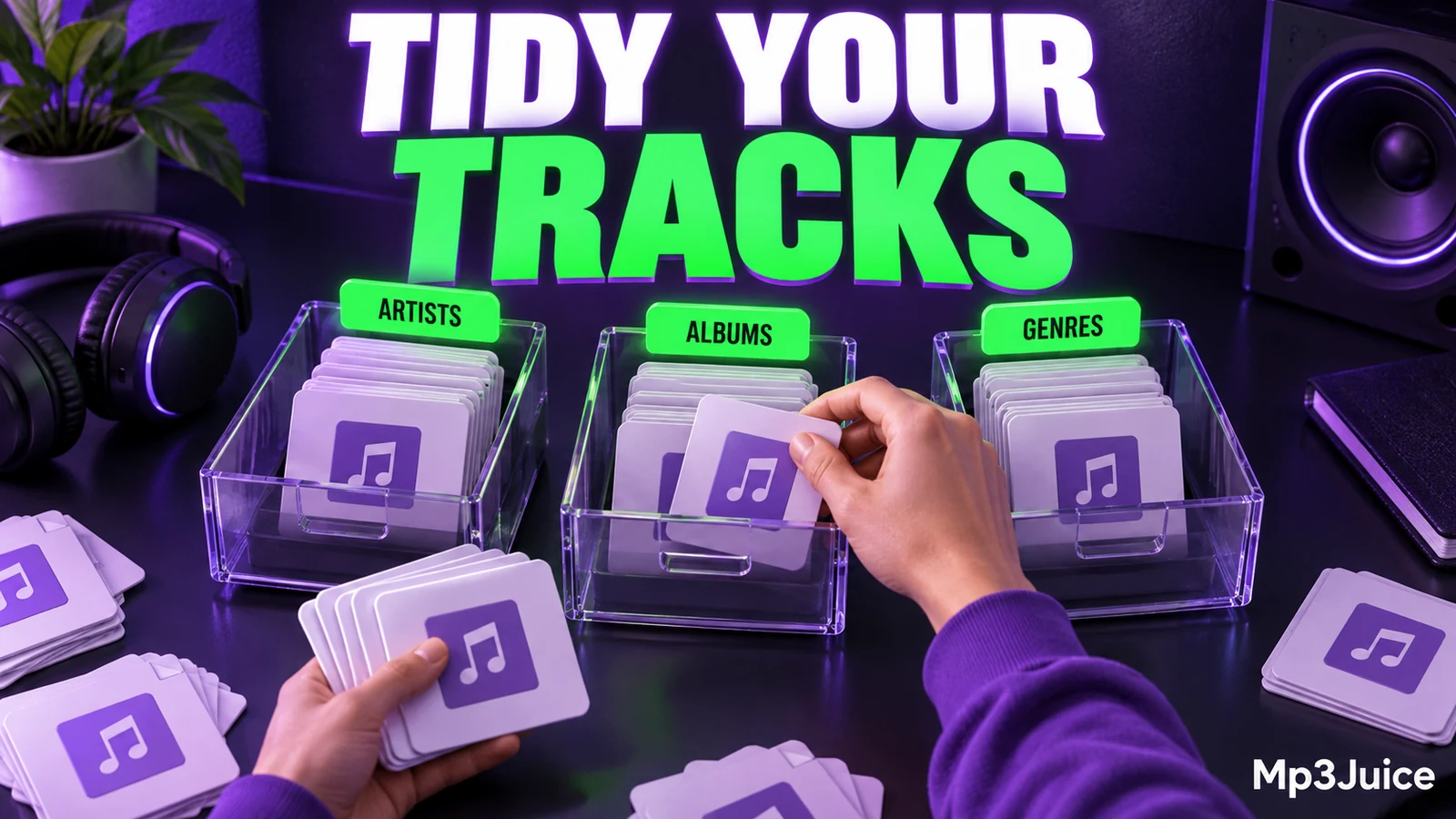
Filenames and tags can contain similar information, but they do different jobs. A filename is what you see in your operating system, backup drive, USB folder, or file picker. Tags are stored inside the audio file and are read by music players to show fields such as title, artist, album, and track number.
Because the jobs are different, fixing one does not always fix the other. A file named Lina Vale - Harbor Lights.mp3 may still appear as Unknown Title in a player if the title tag is empty. A file named track_008.mp3 may display correctly in a player if its tags are complete, but it remains difficult to identify in a normal folder or backup.
Use filenames to make the file recognizable outside music software. Use tags to make the same file sort and display correctly inside music software. If you want a closer explanation of title, artist, album, and track-number fields, read how mp3 tags keep a music library organized.
Make a Backup Before Batch Edits
Batch renaming and batch tag editing can save time, but they can also multiply mistakes. Before changing groups of files, copy the original folder to a separate backup location. Keep the same folder structure in the backup so you can compare old paths with new paths if a playlist stops working.
Do not delete unidentified duplicates during the first pass. Similar files may be different versions, different formats, edited copies, or tracks with missing tags. Move uncertain items into a review folder such as Music_Review and add a short note if needed. Preserving the original gives you a way to recover from wrong assumptions.
- Copy the existing collection to a backup folder.
- Create a staging folder for files you plan to edit.
- Rename a small group first, then check that the files still play.
- Edit tags after the filenames are clear enough to identify.
- Update playlists only after folder and filename choices are stable.
- Keep the untouched backup until the migrated library has been used successfully.
The reason for this order is simple: filenames and folders affect paths, while tags usually affect display. If a playlist points to a specific path, a neat new name can still break playback unless the playlist is updated.
Manage Collaborators and Versions
Small shared collections often become messy because each person invents a naming habit. One person adds dates, another adds moods, and another keeps several files called final. Before moving shared music into a clean structure, agree on a main folder pattern and a version rule.
For finished listening copies, keep names clean: Artist - Title.mp3. For working or alternate versions, add a controlled suffix before the extension, such as Ronan Pike - North Pier live edit v2.mp3. Avoid vague labels such as better, new, or latest because they only make sense to the person who wrote them.
A short changelog can prevent accidental overwrites. It can be a plain text file in the root music folder, with entries such as 2026-02-10, Mira: corrected album tags for Lina Vale tracks; playlist updated. The value is not paperwork. It gives the group a memory of which files were renamed, moved, replaced, or left for review.
Playlist files, including common formats such as M3U or PLS, may reference paths. If a playlist points to Music/Lina Vale/Harbor Lights.mp3 and you move the file to Music/Lina Vale/Blue Rooms/Lina Vale - Harbor Lights.mp3, the playlist may need an update. Keep originals and old paths until the new playlist has been checked.
Fictional Before and After Example
Here is a fictional household migration. Nia, Omar, and Jules each saved a few local tracks into one shared folder. The files play without a network connection, but the names and tags are inconsistent.
| Before migration | After migration | Why the change helps |
|---|---|---|
| Downloads/song-lv-final.mp3 | Music/Lina Vale/Blue Rooms/Lina Vale - Harbor Lights.mp3 | The path now identifies the fictional artist, album, and title without opening a player. |
| Downloads/ronan-live2.mp3 | Music/Ronan Pike/Live Notes/Ronan Pike - North Pier live edit v2.mp3 | The version suffix separates a live edit from a finished studio copy. |
| Downloads/track_008.mp3 | Music/Marlo Finch/Singles/Marlo Finch - Paper Lantern.mp3 | The original name gave no useful browsing information. |
After renaming, they edit tags to match the intended display in their players. The fictional Harbor Lights file gets the title tag Harbor Lights, the artist tag Lina Vale, and the album tag Blue Rooms. They keep the old Downloads backup and place uncertain files in Music_Review instead of guessing or deleting them.
Decide Whether to Edit the Filename or the Tags
When a collection is small, it is tempting to fix every field at once. A better method is to identify the problem first. The table below shows how to decide.
| Situation | Edit filename? | Edit tags? | Reason |
|---|---|---|---|
| Filename is track1.mp3, but tags show the correct fictional artist and title. | Yes | Only if details are missing | The player may display it well, but the file is hard to recognize in folders. |
| Filename is Marlo Finch - Paper Lantern.mp3, but the title tag is blank. | No | Yes | The storage name is clear, but music apps may sort or display it poorly. |
| Filename and tags are both unclear. | Yes, after identification | Yes, after identification | Guessing can create confusion, so identify the file before editing. |
| An existing playlist points to the current file path. | Only if you will update the playlist | Usually safe | Changing a name or folder can break the path; changing tags normally does not. |
The plain reason is that filenames protect findability at the storage level, while tags protect findability inside music software. Playlist references depend more on location than metadata, so rename carefully once playlists are in use.
Finish With a Small Migration Check
- Confirm files are complete local audio files, not pages, shortcuts, or placeholders.
- Copy originals before any batch rename or tag edit.
- Use one stable folder pattern consistently.
- Rename for human browsing, then tag for player display.
- Use clear version suffixes for collaborators.
- Preserve old paths until playlists have been checked.
- Test important tracks offline after migration.
If you are saving individual audio from a video source, YouTube to MP3 is the more specific workflow. For broader single-file saving, MP3 Downloader covers the download-focused path. Once the files are local, the organizing rule remains the same: back up first, rename carefully, tag intentionally, and protect playlist references.